
Book VI Narrative maps art and audio
Public edition ·
Campaign introductions use a dispassionate historian’s documentary voice. They explain causes, named commands, concentration and operational manoeuvre, then stop at an unresolved situation. Mission briefings provide the immediate commander’s task and tactical detail.
Prewar causes in the campaign films
Each film establishes only the crisis events that have occurred by its date. Early German introductions can refer to warnings and postponed demobilisation; the southern introduction can explain the transit dispute, rupture in Prague and civil war once those events have happened. Explain political support and Soviet confidence as distinct from actual consent to occupation. When Moscow’s expectations are narrated, they must be an authored premise of the selected history, not a claim that a historical document proves the fictional plan. The real May 1946 election is research context, not information available to an April character.
At theatre scale, show the relationship between the German front, Czechoslovakia and the Austrian occupation zone. At command/division scale, show competing authority and the emergence of the Bohemian concentration. At battalion scale, resolve the actual opening allegiance and locations; do not recolour an entire division merely because its HQ changes hands. Detailed garrison, depot and evacuation tasks belong in mission briefings. Neutrality or contested control must be explained through the dated map state, not a generic nationality colour. Retained formations can appear with dated concentration/retention annotations in the storyboard; game-rule explanations stay outside narration.
Narration
Keep game mechanics, decklists, unlock thresholds, performance formulas and design decisions out of the campaign narrator’s language. Explain operational facts: a formation is assembling, equipment is scarce, a government has released support, or a road must remain open. Do not predetermine the player’s route or claim a victory or defeat that the saved world contradicts.
Historical attribution and in-world uncertainty matter. Patton’s accusation remains unproved. A fictional command appointment must be dated and plausible. Names and ranks need verification. Rokossovsky’s German-theatre role and Konev’s assigned summer role are adopted fiction; captions, narration and markers must agree on that hierarchy.
Mission command voices
The divisional commander is the recurring mission-briefing voice for that division’s battalions. Use the dated commander and operational assignment in the force register, including for Soviet and other playable factions. The historian remains the campaign-introduction narrator; Eisenhower, Bradley, Rokossovsky and Konev establish higher intent without routinely delivering individual battalion tasks.
Briefings describe the immediate objective, reported enemy, terrain, available support, timings and commander’s intent in period language. The speaker knows only what that headquarters could know at that moment. Do not mention deck construction, unlock formulas or the results of future operations. Authored dialogue is fictional dialogue, not a claimed historical quotation.
For a mixed force, explicitly identify the controlling HQ and lead speaker; supporting commanders can contribute attributed lines. Independent artillery, AA, logistics or security units keep their actual command relationship, and a company-scale introduction may use its immediate commander. These exceptions do not attach independent support counters to a division merely to provide a voice. Commander handovers and availability follow the same dated campaign state; no absent commander speaks without an authored explanation.
The original 30 October research pass covers 20 division-level identities/placeholders with 13 historical incumbent matches and seven conditional proposals. The retained-force expansion adds seven commander vacancies, bringing the register to 27 identities; no new commander is silently appointed or duplicated. Roberts and Rudnicki remain the two existing named selections; the other appointments are recommendations pending adoption. The force register includes period ranks, dated availability limits, source references and provisional performance directions. The final Fulda divisional ledger, adopted fictional transfers, remaining exact rank/handover dates, native-speaker pronunciation, portraits and recordings still require completion. Performance directions are authored interpretations, not verified historical voices. Division command cast
Map hierarchy
Campaign introductions use exactly three map-detail levels (owner direction, 1 November 2026). Multiple narrative beats may share a level; they do not create additional hierarchy levels.
- Theatre: establish the wider war with theatre commands and their commanders only. Do not plot subordinate field armies, corps or their commander portraits at this scale. First Orders begins with the pre-war occupation zones. Subsequent campaigns show belligerents and dated front lines inherited from the preceding campaigns; occupation boundaries remain a separate historical reference, never a substitute for current control. Where the saved world is unavailable in a review, label the assumed history or unresolved extent explicitly.
- Regional field army / corps: combine field-army and corps organizations in one campaign-relevant regional view. Remove theatre/supreme-command portraits and markers from this map; express parent relationships in the command tree rather than retaining higher-level map context. Show their command relationships, principal unit concentrations, adjacent responsibilities and operational movements. Equivalent troop commands retain their actual titles and ranks; administrative occupation districts are not automatically field corps.
- Division and campaign deployment: show the frontline order of battle, division affiliations and every independent regiment, battalion and company on the actual campaign map. Use NATO-style symbols and sourced division emblems. Show later contributions at their assembly positions or approaches, clearly separate from the initial deployed force. Planned later arrivals do not become opening stock. This is a deliberately dense view; enlarge or allow geographic zoom rather than hiding stationary counters.
Air commands appear at theatre scale; groups, bases and coverage at regional scale; relevant squadrons and allocations at division/campaign scale.
Use geographically continuous, north-up transitions. Broad manoeuvres establish context; individual road connections and tactical implementation do not organise the whole intro. The last frame must use the same branch-specific opening record as the campaign map. A parent aggregate resolves into children without adding stock. Within a dated shot and scale, stationary formations remain present as the camera moves; do not cycle through visibility subsets to solve crowding. A scale change must visibly connect the parent and its children. A unit leaves only through geographic framing, an explicit movement, a dated change, or that explained aggregation change. Establish the static theater and sector organization before rebuilding animated sequences.
Use period-style paper cartography and restrained coloured overlays. For theatre commands, armies and corps, use a readable national flag centered on the registered headquarters coordinate, with the short command name below. At the theatre/national-command layer, add a chest-up cutout from a sourced historical photograph of the dated commander above the flag. Preserve facial and uniform detail, use a restrained monochrome archival treatment and remove the rectangular background through masking. The flag remains the geographic anchor. Name the commander; change the portrait with dated handovers. Field armies use smaller chest-up commander portraits with the same neutral black-and-white treatment; corps retain the flag treatment. Army/corps views show their own command tier. This portrait composition is an owner-directed review proposal pending visual acceptance. Use the national flag for every higher command, including Third Army. Keep oversized NATO headquarters frames and stacked echelon Xs out of these levels. At division and battalion detail, retain the verified emblem, NATO-style branch symbol, echelon and short title. Move each complete marker as one object. When army markers collide or cover a location, place the smaller army portrait, flag and name in the nearest readable open space and draw a thin location arrow ending at a small dot on its exact registered HQ coordinate. This owner-authorized exception moves the annotation only; it never changes the formation location. Keep location arrows visually distinct from maneuver arrows and keep their endpoints visible. Do not use displaced rectangular title boxes. Movement arrows may show actual or intended manoeuvres; distinguish those meanings.
Use the same active command-role tier across nations in a dated frame: theatre/national commands, then field armies, field corps, divisions and the campaign’s battalion/regimental cores. Geography and organizational detail are separate controls. USFET, BAOR, the French occupation command and the Soviet theatre command belong in the top command view; Third Army, the Soviet field armies, the explicitly re-formed British Second Army and Monsabert’s historical occupation-troops command belong in the army/troop-command view. The French counterpart keeps its actual title and is not relabeled a field army. This presentation grouping does not rewrite their historical establishments or imply equal strength. Higher parents remain in the command tree, not as markers or portraits on the regional map. Classify by command role: BAOR remains a theatre command despite its title; an operational army-group headquarters may belong in the regional view. British occupation corps districts are administrative commands and must appear in a separately identified district overlay or register, not as field corps peers. Keep genuine direct army-to-division relationships; do not invent a corps to fill a display tier. An unavailable HQ location stays unplotted and explicitly listed rather than acquiring an invented coordinate. The command tree remains available across the detail views.
Political or administrative boundaries, pre-crisis occupation boundaries and current military fronts are separate layers. Political borders use a fine solid line, occupation a neutral dashed line, and current fronts a heavier outlined line. Blue and red operational-control fills belong to dated control snapshots; the regional overview also uses separately defined broad alignment background shading as specified below; hatching marks unconfirmed control in operational-control views. In pre-war occupation views, US-colored diagonal stripes specifically identify the American Bremen/Bremerhaven enclaves over the British background, with no enclave boundary outlines; no map key is displayed in the campaign intro. Hamburg retains the British occupation tint. Occupation-zone names sit in clear space within their own zones, separated from commander portraits, flags and command labels; use stable placement on landscape and narrow review views. Preserve national borders and other occupation boundaries. Arrows never transfer territory. Nationality and HQ allegiance do not establish control of the surrounding country. Tactical influence and movement-blocking zones remain a separate game-rule concept.
The April films use local opening snapshots. Southern control corridors are authored against initial battalion positions; they do not declare all of Czechoslovakia securely held by one side. Neutral Summer has no fixed control fill, front or battalion opening until inherited campaign state exists. Explicitly labelled owner-review scenarios may show a declared assumed history, front, control sector and battalion deployment; they are illustrative proposals and never claim to be the player’s saved result. Theatre views show a front without area washes; local control reports have a clear sector edge. Oder–Neisse remains a period administrative demarcation, without implying a final peace settlement. In operational-control shots, German and Austrian occupation outlines carry no faction shading. A dedicated pre-war occupation-reference shot may use four distinct national tints at the owner’s request; these are not the two belligerents’ wartime control colors. Berlin and Vienna retain their joint-administration exception.
Division and battalion symbols remain large regardless of roster density: approximately 52 pixels across the NATO frame on desktop and at least 32 on narrow views, with enlarged emblems. Higher-command flags and their names must remain readily legible at the corresponding scale. All formation locations stay at their geographic anchors or authored route positions on every screen size. The smaller field-army portrait annotation may be offset only with the explicit exact-HQ dot and location arrow described above. Resolve density through framing and a stable roster for each explicitly identified scale; offset annotations retain their anchored location arrows. Omit the map key entirely. In crowded groups, especially at Helmstedt in the regional and division views, retain NATO symbols while suppressing overlapping names, captions, portraits and emblem detail as needed. Preserve each independent unit, its geographic anchor and inspector identity; simplify detail rather than hiding or merging the inventory. Use stable placement throughout a shot. At theatre scale, keep USFET in a fixed vertical stack: portrait above flag, centered command label below. Place the Frankfurt town label to the right of its city dot, clear of the command. Preserve exact headquarters and city coordinates. The owner approves the remaining theatre composition. Detail views must preserve the complete underlying deployment, not swap disjoint unit subsets. Town registration improves the geographic placement of schematic cells. Cells, identities and stock do not change. These are authored scenario locations, not surveyed historical deployments. The dense southern opening uses successive north-up sector views with a campaign-area inset, retaining the same opening inventory across the tour. The storyboard viewer exposes the corresponding detail plates.
NATO-style symbols are a viewer-facing production convention, not evidence that NATO exists in 1946. Unverified insignia need a disclosed parent/national fallback. A fictional German badge is not a recovered historical emblem.
Scripts and storyboards
The working script register holds the current imported review drafts for all five campaigns. Summer uses a provisional Fulda outline with authorship distinct from the Opus-authored campaign drafts. They are drafts, not unconditional canon. Full branch clauses, dates, force-source gaps and map variants remain to be reconciled.
Concurrent cinematic source, recorded audio and previous storyboard renders are implementation/evidence surfaces. They do not independently amend the Bible. Future script changes are made in the working script register and this book, then exported into production assets. The generation step must record the Bible state it used.
A complete scene specifies narration, visible geography, map level, displayed formations, movement start/end, ownership, camera transition and evidence/asset status. Earlier rendered previews omit some intended insets, overlays and camera treatment; a written direction is not a finished effect. Current film production compiles the living register into animated geographic maps and sentence cues.
Retained-force storyboard revision
The scripts now show the seven adopted theatre additions at their correct narrative level: 49th, 51st and 52nd Infantry, 11th Armoured and the Canadian occupation division around BAOR; US 3rd Infantry in Hesse and 4th Armored in the Danube rear. 11th Armoured stays behind as 7th moves south. 51st stages to the lower Elbe rear. The southern film separates the American mobile reserve from the later German and Czechoslovak formations. Narration describes preparation and commitments without game mechanics.
Generated plates accompany each shot in the script register. They use the same HQ, movement and battalion-placement records as the text. Anchored emblems, branch symbols and titles move together; arrows represent movement only. National/parent fallbacks remain disclosed where divisional art is unverified. The summer origin plate is explicitly a conditional availability study: it must not be mistaken for an approved Fulda opening or a claim that all formations survive. The storyboard plates remain review assets. The film compiler now derives runtime scenes from those same current records; the production section below distinguishes completed work from remaining campaign-state integration.
Summer narrative variants
The same Fulda strategic problem can mean Soviet exploitation, an uneven-front opportunity, deadlock-breaking, recovery of initiative or a last-reserve counterstroke; it can also become an Allied-led eastward offensive under one combined operational commander, with Konev defending. Establish the initiative before selecting the rationale. Select the rationale from the full saved world, then write sector-specific facts and intentions. The campaign register holds proposed families and guards; the script register carries corresponding provisional clauses.
Use a common map/scene structure with interchangeable narration, front lines, concentration movements and opening forces. Show Rokossovsky at theatre scale, Konev over the assigned summer command, and Bradley over the assigned coalition force, under Eisenhower with Montgomery as deputy at supreme headquarters. The eastward Allied branch changes the operation’s objectives, defensive preparations, reserves and opening state as well as the direction of its arrows. Do not manufacture a separate fixed film for every result tuple or assume that result labels alone describe the war. Track every legal history, including defeats; unknown data permits a factual neutral clause, never an invented event. A missing feasible operation requires a compatible alternative, not merely a different voice-over on the same false map.
Epilogue presentation
Use the three-slide structure in Campaigns: ground, cost, next operation. Show actual territory and surviving formation identities. Reserve result labels for the result presentation; the next historian narration explains military consequences in ordinary language.
Visual identity and assets
Use the canonical Omega War brand kit: the selected Omega emblem and outlined title lettering, with horizontal or stacked layout appropriate to the format. Preserve aspect ratio and clear space. Keep faction insignia separate from the Omega logo.
Models should have the correct silhouette, weapon, crew, mobility and national identity. Generic proxies, static crew and missing animations remain explicitly incomplete. For equipment adaptations, explain mounting, ammunition, crew duties, firing arcs and tradeoffs. Original low-poly/procedural assets may be stylised while remaining physically coherent.
Period photographs, films and emblems require traceable sources and use rights. Source identity and licensing are separate from visual acceptance. Geographic boundaries, placement approximations and authored routes remain visible in production metadata.
Audio
In-game briefings may use TTS. Social and showcase exports may not contain synthetic, TTS or cloned speech, including speech captured from the game. Use effects/music/captions or verified human recordings for those exports. In-game audio retains its own permitted speech policy.
Combat, movement, loading, impacts, repairs, environmental sounds and UI cues need verified correspondence with action. A sound labelled recorded, foley, designed or surrogate retains that provenance. A catalogue entry or an audio track does not prove that it was listened to, synchronised or approved. Captions and silent fallback must remain usable when audio fails or autoplay is blocked.
Production owns verification and handoff status; archive receipts remain historical evidence.
Southern documentary prologue
The Bavarian Front now opens with five documentary beats: Moscow’s miscalculation; the Soviet-backed authority and divided army in Prague; Beneš in the American zone; the Democratic Independent Czechoslovak National Army (ICNA) assembling; and Patton reforming 1st Panzer. The eleven-shot script then resolves command, division and battalion maps, preserving the proposed opening roster. Its estimated editorial duration is approximately 4 minutes 22 seconds. The prologue adds this regional crisis without retelling the entire shared outbreak film.
Use a dispassionate historian voice, period archive cutaways and paper maps. Beneš’s policy reversal supplies the dramatic connection: cooperation with Moscow had been intended to protect the republic; Soviet coercion now drives its president toward the Americans. Avoid invented quotations, counterfeit historical headlines or footage presented as documenting the fictional takeover. Dates appear as chapter information rather than separately spoken headings.
The map plates show three editorial cutaway beats beside each prologue map. These cutaways remain storyboard directions pending acquisition. Beneš (circa 1942) and Gottwald (dated 1946, month unknown) portraits have now been acquired with item-level public-domain evidence. Nosek remains on the map because suitable reuse rights have not been established. Railway, registration and additional workshop cutaways remain optional acquisition work; the produced map scenes convey those beats without fabricated footage. The existing Southern-owned wartime Patton portrait can appear with its actual archive description. Preserve exclusive film ownership of archival material. Civilian authorities have circular markers without military echelon; the Free national organising staff is STAFF, not XXXX. Both Czechoslovak sides retain the national flag. Military units retain their emblem/branch/echelon anchors and existing movement paths.
Regensburg-area civilian/staff positions illustrate the American rear; the final seat and escape route remain open. The ICNA and German divisions are forming. American liaison mediates continuing German–Czechoslovak distrust. No mission mechanics, recruitment formulas or campaign-rule explanations enter narration. Result-conditioned campaign opening records remain production work; the runtime film pass and exact audio verification are recorded in Book VII.
Campaign film production from the Bible
The production compiler converts each canonical sentence into a stable caption/recording cue and each map scene into its current headquarters, battalion opening and authored movement paths. The camera moves north-up through theatre, combined regional army/corps, and division/campaign deployment views. Higher-command flags and names share one geographic anchor; at division and battalion detail, emblem, branch symbol, echelon and short unit title share one moving anchor. Parent aggregates are replaced by the visible child layer rather than added to its combat stock. Detailed map identities remain available in the film’s Sources panel when a small display cannot show every title clearly.
Summer has a neutral film for an absent prior record and six explicitly selected situation studies: exploitation, uneven front, deadlock, recovery, last reserve and Allied offensive. Their directions and operational tasks differ. No automatic evaluator of victory grades is implied, and no missing summer battalion inventory is fabricated. Validated saved-world selection and the final inherited summer opening remain campaign implementation work. The new summer command markers indicate authored areas, not researched exact HQ buildings or new combat strength.
The campaign score is Phoenix (2026 chamber-strings arrangement), Scott Buckley, used under CC BY 4.0 with credit. Use its restrained string arrangement, soft entrances/exits and a lower level under narration for subtle drama. Technical loudness and decoding checks do not constitute subjective listening approval. Composer source
Owner-review film corrections — 30 October 2026
Map symbols remain anchored to geographic coordinates in every viewport. Dense scenes use closer views and successive formation layers; co-located artillery, AA and supply units remain independent counters at the same geographic point. Short labels use registered identities where known and descriptive type/parent titles where identity remains unresolved. They do not invent unit numbers. Forming divisional staffs use dashed HQ frames; the German cadre has no armoured-division oval before its combat formation arrives. Hatched Czech frames indicate reliability contested while obeying Prague orders, not automatic neutrality or defection.
The Southern review presents the authored Soviet Bohemian Group and its illustrative concentration route. The 39th Guards Rifle identity is historical; its Franconian commitment is an authored assumption. These disclosures remain in the owner review and Sources rather than in the documentary narrator’s voice.
Each opening counter must appear in the granular sequence. Final holds may return to the covering battalions and reconnaissance screen after independent support locations have been shown in preceding sector views. Visibility sequencing never removes a support counter, changes its coordinates or attaches it to a mainline unit.
Town names stay beside their own visible geographic dots, within 24 pixels of the label edge. A label may not sit nearer another visible town, and a town hidden under a formation is omitted from that formation layer. Narrated towns receive a clear geographic context pass when needed. Sparse views retain a nearby named place, dated control wash or visible front; camera composition must not leave a formation isolated on an unidentifiable blank field. This rule applies to landscape and portrait and never changes formation coordinates.
Visual authorship and review
Owner direction, 30 October 2026: Claude Opus 5.5 handles campaign-introduction visual design and implementation from this point. Codex coordinates the force register, historical research, verification and private delivery. Verify the actual model used; a differently named agent is not a substitute. Return visual layout corrections to Opus. The army/corps sector study is a static campaign-intro mockup awaiting visual acceptance and film production. Occupation districts, field corps, headquarters localities and operational deployments must remain distinct.
Three-level storyboard review
The current proposed sequences are stored under three_level_storyboard for each campaign in the working script register. They contain narration, map bounds, formation references, animation beats, reinforcement distinctions and end-state guards. First Orders has eight beats; Helmstedt and the Northern Front nine each; Bavaria nineteen including its documentary prologue; Summer Decision seven neutral beats plus six alternative seven-beat sequences. Timings are editorial estimates pending voice recording. The variants are hypothetical example histories, not saved player results.
Open the three-level graphic and animation review (private). The older recorded films and fixed map plates remain prior production references.
Landscape review handoff
Opus visual revisions include finished landscape screenshots from the actual map renderer. Supply 16:9 map-only views with units and labels at theatre, regional army/corps and division deployment levels; include populated result-dependent branches where the neutral state has no fixed opening. Preserve exact geographic anchors and report the captured campaign, branch and step. Provide the screenshots directly and through the private review gallery so portrait-only Sites viewing does not prevent landscape composition review. These review screenshots are not final exported films.
Regional overview emphasis
On the army/corps map, formations outside the striped campaign/control area use substantially larger markers and labels (approximately double the compact size). Classify membership by geographic anchor, never by displaced text. Keep the dense inside-area presentation compact and retain every independent identity.
First Orders retains national occupation-zone colors at every map level. Subsequent campaigns use Allied blue and Soviet-aligned red for established territory across the theatre, regional army/corps and division views, including territory outside Germany. Neutral or uncommitted countries remain parchment. Contested territory uses hatching; a distinct dated military front separates known control. Political borders and subdued pre-war occupation boundaries remain separate from that front. Solid faction fills identify controlled land; a campaign coverage rectangle does not itself establish contested ground.
Dated campaign-state territory overrides the wider background, including any changed occupation-zone ownership. Known country alignment and last-known occupation footprints supply contextual baselines only where not superseded; they must not silently reset prior campaign outcomes. The unresolved Summer Decision study leaves German control uncertain until a branch or saved result supplies it. Selected review branches remain explicitly hypothetical, not saved player results. Czechoslovakia remains disputed outside its established control polygons, and jointly administered Berlin/Vienna retain their exception unless dated control supersedes it. Proposed contingents alone do not establish national belligerency. The current review has no live player-save integration; the renderer must accept supplied wider control without treating an absent state as proof of unchanged front lines.
Broad maneuver arrows and phone readability
Maneuver arrows use broad, clearly visible shafts and arrowheads: Allied blue and Soviet-aligned red. Route, forecast and intention treatments preserve their meaning through pattern or opacity without losing faction color. Draw maneuver arrows beneath formation symbols.
Make formation symbols and emblems substantially larger for small screens, judged at the displayed phone size rather than only at source resolution. Keep interactive phone maps readable at native scale with scrolling or zoom; retain landscape film composition. Do not rely on shrinking a wide film to phone width. Use closer framing or panning where needed, compact labels in crowded formations, and leaders to unchanged geographic anchors. Preserve every independent opening identity and the three adopted command levels. Ordinal suffixes remain lowercase (5th, 26th, 32nd); acronyms and Roman numerals retain their proper capitals.
Southeastern approach beat
The southern division level adds one short documentary beat on the southeastern approach. The detached 51st Armored Infantry Battalion stands on its post near Wegscheid, facing Soviet Upper Austria. The beat has no movement or arrow. Every division view keeps all initial counters (95 since the coherent-front update) on the sheet; emphasis may change, but no unit is hidden.
Coalition and conditional traces
A short regional beat shows the French support group at its Ravensburg–Biberach assembly. Its possible route via Ulm into western Bavaria is a broad dashed blue arrow, narrated only as: “Beyond the western approaches, French forces assemble. Their commitment will depend on the course of the fighting.” In the division beat on forces still assembling, the French west entry and the Slovak volunteer route are inked as dashed anticipated traces beneath the counters. Neither carries a counter, fades or adds to the initial count. All 95 initial counters stay on every division sheet. Historical and fictional notes live in the data, not on the film.
Forest roads beat
A division beat after the southeastern approach shows the forest frontage. Forward 39th/47th battalions stand on the roads, reserves sit behind, support is offset as separate counters and the Southern Forest group stands east on the Czech side. Narration names the 47th, 39th and the Soviet group as documentary fact within the fiction, without mechanics and without claiming a historical 1946 deployment. All 95 initial counters stay visible and nothing moves.
Wooded corridor beat
A division beat after the forest roads shows the Schönsee–Tiefenbach–Waldmünchen corridor. 1/7 and 2/7 stand on the roads, 3/7 sits in reserve at Rötz, the 7th group support is offset as separate counters, and the CS11 corridor battalions and companies stand east on the Czech side. The narration presents the 7th Infantry and the Czechoslovak battalions as documentary fact within the fiction, without mechanics, and recalls the April 1945 crossings as history. All 95 initial counters stay visible on their posts, and nothing moves.
7th Infantry Group on the map
us7-group appears only at the regional (sf-r4) and division (sf-d3w) levels, where it gives the detached battalions their command context. It never appears at theatre level, and no counter moves to make room for it.
Southern coverage to the tripoint
At theatre, regional and division level the southern frames run as one stepped outline from Franconia to the Haidmühle tripoint and the Wegscheid screen. Allied and Soviet fills follow the dated line; Austria keeps its occupation-zone colours and is not painted as a front.
ICNA and CSLA naming and formation-stage handoff
Owner-selected 6 November 2026: use ICNA (Democratic Independent Czechoslovak National Army) and CSLA (Communist Czechoslovak Liberation Army) in future scripts and map labels. Present the opening ICNA detachment and CSLA battalions before depicting later supplied formations; no full division appears from an institutional army title. The resistance story concerns local political organization and the memory of German occupation, not a universal national allegiance. TO&E, recruitment formulas and guerrilla activation thresholds stay out of historian narration. Recorded audio, films and graphic assets still require synchronization with these names and formation stages.
Campaign requisition drawer and formation images
Owner direction, 6 November 2026: use Wargame: Red Dragon’s strategic campaign interface and WARNO Army General’s illustrated formation choices as references. The requisition menu is a restrained drawer over the campaign map, with compact image cards, a narrow roster panel, parent-command and role filters, and a quiet selected outline. Avoid a full-screen catalogue, large serif headings, repeated parent captions and oversized price/status blocks. Closing the drawer reveals the map; reopening retains selection, orders and wallet. On phones the drawer becomes a compact sheet with scrolling cards and details.
Each formation card uses an portrait of an actual in-game model that best represents its equipment/role. The portrait represents one unit; the formation roster defines its full composition and finite stock. Stage the unmodified game geometry and materials in an outdoor visual-test scene; record source card ID, model, pose and national-appearance caveats. The portraits are staged renders; tactical-combat frame capture remains a later art refinement. No commercial screenshot or AI illustration is used as Omega War unit art. Missing Panther, Somua S35 and Panhard 178B models receive explicit image-pending placeholders. Do not relabel another tank or armored car as one of those types.
The Bavarian opening review plate supplies the menu-context backdrop at its registered geography and placements, retaining Opus’s map authorship.
Visual references inspected: WARNO’s official illustrated formation choices, Red Dragon campaign orders/roster panel (mod screenshot, interface reference only), and the official Red Dragon campaign manual. Reference captures remain research evidence; the shipped menu uses original game assets.
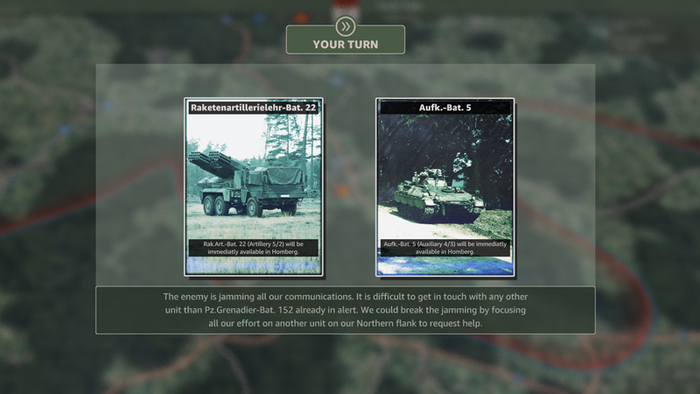
Formation cards also carry a small identity-emblem badge over the portrait, repeated in the selected-formation panel. This is separate from the NATO branch/echelon symbol. Use an explicitly registered emblem when available; do not silently borrow a parent division’s badge as a battalion’s own insignia. Otherwise use a restrained shield placeholder with a question mark and national abbreviation, labeled “Formation emblem pending.” Missing or failed images fall back to that placeholder. The current 32 reinforcement formations have no registered emblems and therefore display placeholders; this creates no fictional historical insignia.
Southern intro research and disposition review — 6 November 2026
The generated private reading view includes a Southern opening research page with a proposed chronology, ICNA command chain, nuanced Prague/Soviet roles, period-media references and a map of all 95 initial formations at their existing registered coordinates. This is a data review, not an Opus intro-map replacement or a playable deployment. The current roster is 139 entries: 95 initial, 44 later.
Four inspected stills illustrate Beneš (circa 1942), Gottwald (1946), Czech officers in wartime Britain (IWM H 8185), and Stalin/Molotov at Potsdam (18 July 1945; Truman Library 63-1457-52). Each retains actual dates, credits and rights evidence. Dukla soldiers, Nosek, other officer portraits and archive films remain catalog leads where rights are incomplete. Kutlvašr’s selected 1945 portrait is recorded separately below. No real image is described as depicting the fictional 1946 crisis. These research copies create no new film allocation: check exclusive image/reel ownership before scheduling. Full media provenance lives in forces.json → southern_intro_research.media, with research assets under assets/southern-research/.
Southern three-level map revision — 6 November 2026
The existing Opus 5.5 theatre, regional and division storyboard now uses the researched 29 April 1946 proposed opening and the staged February–April crisis. Date headings stay on screen; narration begins with the narrative sentence. The theatre view explains rival civilian authority; the regional view keeps the ICNA national organizing/field command separate from American operational coordination; the division view retains all 95 opening formations at their registered coordinates.
The primary ICNA military command station identifies proposed senior commander Kutlvašr. Píka’s staff/liaison role is supporting inspector detail; Liška remains with the forming division. Typeset labels carry these roles without inventing portraits or combat strength. Fierlinger/Gottwald/Nosek/Svoboda retain their spring offices. ICNA is two opening formations, 220 personnel. The 44 later entries, including six conditional French formations, remain off the opening board; later releases requisition whole formations. Exact crisis dates, new appointments and allegiance branches remain review proposals.
The three-level reading view and maneuver sequence use scripts.json → southern-front → three_level_storyboard as their canonical plan. The retained three-level renderer provides the operational source; encoded films, voice tracks and playable campaign integration remain separate production work.
Senior military leader presentation — 6 November 2026
Owner direction: military maps present the senior military leader of a command. For the ICNA, Kutlvašr is the primary national/field-command identity on theatre and regional views. Beneš remains civilian authority in political-story context; Píka is supporting staff/liaison detail; Liška is the forming division commander. Do not combine commander and chief of staff into equal primary billing. The existing national organizing-staff anchor may appear on both relevant levels as a presentation exception; its staff echelon, 220 opening personnel and two formations do not become a field army. Keep higher-command flags tied to exact stored anchors, preserve all 95 initial formations and use source-cleared portraits only. The choice of display identity is adopted; dates and fictional appointments remain proposals.
Kutlvašr archival portrait — 6 November 2026
George approved inserting the uniformed portrait catalogued as 1 June 1945, 640 × 911 pixels, in Kutlvašr’s existing theatre and regional command marker. Preserve the original photograph with a subject-following SVG mask and restrained monochrome treatment; retain the exact national staff anchor and all formation positions. The image comes through Wikimedia Commons from Jindřich Marek’s Barikáda z kaštanů (2005), photographer unknown. Commons records PD-anon-70-EU; United States/worldwide status is not established by that listing. Owner authorization covers this private review reference; wider distribution remains subject to item-level rights review. No new film allocation, formation or appointment is implied. Provenance and the original checksum are in forces.json → southern_intro_research.media → kutlvasr-1945 and sources.json → film-production → kutlvasr-portrait.
Southern archive selection — 6 November 2026
The core selection now adds two silent 640 × 480 excerpts from Universal’s Czechs Fight for Freedom (release 9 July 1945): Soviet vehicles arriving in Prague (source 01:04–01:15) and Beneš returning (01:32–01:35). These are May 1945 scenes, never records of the fictional 1946 intervention or flight. The original download matches the archive’s size and MD5; excerpts were decoded and inspected through frame samples. NARA documents Universal’s public-domain donation; retain item-level credits. IWM H 31998 adds an inspected War Office photograph of Beneš with Czech personnel in Britain under the documented expired Crown-copyright basis.
Use these alongside the acquired Gottwald, Stalin/Molotov and Kutlvašr stills, Western Czech officers H 8185, and existing Southern-owned Patton/motorized-column material. Maps carry the fictional crisis, contested allegiances and the 95-formation opening. Extra officer portraits, eastern-Czech stills and paid archive alternatives remain held where dates, authorship or reuse rights are incomplete; they do not block this core assembly. The raw reel 208-UN-1044 is a backup requiring separate underlying-footage assessment, not blanket CC0 clearance. No licenses were bought and no archive was contacted. The source register and forces.json → southern_intro_research → archive_selection hold the selection, exclusivity comparison and outstanding alternatives. Final narrated-film assembly is not produced by this acquisition pass.
Period geography audit — 6 November 2026
Use Hersfeld in 1946; Bad Hersfeld dates to 1949. The Helmstedt marker at 11.018/52.171 identifies Neu Büddenstedt, not the later merged municipality. Retain Eisenstein, Kötzting, Poběžovice, Bělá nad Radbuzou, Kynšperk nad Ohří and Philippsreut. Haidmühle is a valid settlement label; its municipality remained Frauenberg until 1951. Jochenstein is valid as a locality, but its modern dam and crossing are unavailable. Use occupation-zone terminology, Czechoslovakia and Fulda approaches in period narration. A place-name audit does not certify modern roads, urban footprints or reservoirs as 1946 terrain. Sources, extracted label inventory and limits: forces.json → cartography.place_name_audit_20261106.
Pending narrative reconciliation — recorded 6 November 2026
Review the existing intro against the latest recorded government-in-exile, Seventh Army and French political framing in forces.json → southern_intro_research. These are not yet fresh film/voice deliveries. Preserve senior military leader presentation, source dates and the 95-formation opening. Patton’s fictional satisfaction or political patrons are characterization choices, not historical quotations. A player-facing major is an operations liaison; the actual army chief of staff should have a plausible senior appointment.
Berlin Command period-map references and command slot
Owner-requested framing, recorded 6 November 2026: reuse the shared theatre map, use the Soviet occupation zone for the army/operational overview, and descend to Greater Berlin and its suburban approaches. Source selection and reserved authority are research/presentation records; no final map, film, narration or force deployment is issued. The single detailed record is forces.json → berlin_feasibility_research → map_reference_selection_20261106.
| Level | Selected reference | Use and limit |
|---|---|---|
| Theatre | Existing shared Germany/Austria frame; State Department Germany: Zones of Occupation, ca. March 1946, M644,1:1,500,000 | Reuse existing map composition and anchors. Truman catalogue labels its image public domain; attached frontier-proposal sheet obscures parts and is not a settled-border layer. |
| Army / regional | Schema des Eisenbahnnetzes der Sowjetischen Besatzungszone Deutschlands,March 1946; publisher dates original 20 March 1946 | Whole-zone railway and approach reference. DNB confirms original 1:450,000 and modern reprint 1:585,000; vendor reduction wording differs. Original collar/scale bar must settle calibration. No line serviceability or troop positions inferred. |
| Division / city | Overview Plan of Greater Berlin, 1946, Rumsey 13555.002,1:60,000,Izdatelstvo Sovetskaia Kniga | Primary period sector-map reference; month and exact suburban extent unresolved. Not automatically a 16 April infrastructure return. |
| Division / suburbs | Der Wegweiser von Berlin und Umgebung, 1946, four-sheet series,1:100,000,Tschammer und Sohn | Wider Berlin/environs reference. Holding collection flags inconsistent western boundary revision and some street labels preceding formal renaming. All four sheets/extent still require inspection. |
| Local boundary check | Reinickendorf district plan, 1946,1:20,000 | Temporary Stolpe/Frohnau French-sector extension needs original verification. Does not establish an operational French airfield. |
The earlier 1945 Umgebung von Berlin is a useful terrain cross-check, but its 1940 base omits military airfields and its overprint retains pre-exchange western boundaries. Do not reproduce its Staaken/Seeburg line as the April 1946 line. Keep geographic fact, occupation administration, dated military control and authored wartime positions as separate layers. “Soviet occupation zone” is the 1946 label; the GDR is not yet established.
Reserve the USFET / General Joseph T. McNarney theatre role at the existing Frankfurt anchor. This is a plausible opening higher authority for American Berlin forces, consistent with the accepted national chain. It is not a claim that he historically commanded all Western sectors. Leave the combined Western authority vacant until a dated emergency agreement assigns operational powers; Montgomery and Kœnig retain their national channels. The adopted summer Eisenhower command enters only after its fictional activation. National authority and appointment limits are maintained in BookIX’s shared study.
The regional view is an army-scale view, not a new army or a grant of control over the Soviet zone. Proposed framing includes a western access margin; the city view should include suburban approaches rather than terminate at municipal boundaries. Exact bounds are authored camera proposals, not historical sheet extents. The theatre slot adds no strength or relocated headquarters.
Catalogue records and reproduction policies were inspected. Full-resolution sheets were not visually verified or georeferenced; no scan was saved and nothing was purchased. Rumsey’s policy permits many publication uses but requires underlying-rights assessment for newer originals. The modern railway reprint and other 1946 images are reference discoveries, not cleared game textures. Next inspect complete sheets and reconcile borders, names and scale before tracing.
Independent-source audit — 7 November 2026
Use independent source families, not a count of websites. A dealer listing, library catalogue and reproduction of the same railway map are one cartographic source. A modern scholarly reconstruction is not an original 1945/46 map. Catalogue agreement confirms an object’s identification; it does not demonstrate that every line is correct.
| Subject | Independent checks | Finding and remaining limit |
|---|---|---|
| Theatre / Soviet-zone perimeter | State Department M644 versus Atlanta-Service 1946 original, MSPT 3.2006.3439 | Two separate contemporary producers. Atlanta’s month unknown; museum photograph labels CC BY-SA 4.0 / Peter Boesang. Complete images have not been overlaid or compared line by line. |
| City / environs | Sovetskaia Kniga 1946 plan versus Tschammer 1946 four-sheet series; US Berlin District 1946 guide and LOC Allied military map collection, TN/549, folders29–32 | Independent Soviet, German and Allied reference families. US guide and its 15 July 1946 directory transcription are one family, not two. July facilities are not automatically April facilities; military sheet dates remain to inspect. |
| Broad sector geography | Period maps plus official Berlin-Brandenburg statistical history and GHDI sector reference | GHDI’s title is the depicted date: original cartography 2004, revised2021. It is a modern reconstruction, not a 1945 sheet. Broad sectors corroborated; temporary exceptions still need original records. |
| Regional railway network | DNB bibliography and publisher reproduce/describe one 1946 original | Bibliography independently checked; no second independent period railway map yet certified. March supported;20 March remains publisher-attributed. Scale conflict unresolved. Cross-check perimeter against M644 / Atlanta, not every track. |
| Gatow / West-Staaken | FRUS 14 February 1951, doc.297,Spandau district authority,officialstatisticalhistory | 1945 military adjustment corroborated. Military control and legal/municipal administration are different layers. A later legal or municipal boundary change must not be backdated. Exact 1946 trace and annex remain U. |
| Stolpe / Frohnau exception | 1946 Reinickendorf plan plus1951 FRUS report about nearby Gutshof | French administration beyond legal city boundary is credible; identifying the same parcel or formal transfer of all Stolpe is not established. Keep Stolpe, Stolpe-Süd and Neuer Gutshof distinct. |
| McNarney authority | NARA organizational history plus independent 24 March 1946 JTA report | US European theatre office corroborated near opening. No evidence here appoints him commander of British/French troops. Joint authority stays unassigned. |
Correction to the earlier western-boundary instruction: do not simply erase a municipal line when replacing a stale military-control overlay. Show the 1945 military arrangement and the dated civil/legal boundary separately. A 1951 US diplomatic description, a 1961 incorporation reference in a museum summary, and a 1946 map can concern different acts and different definitions. The conflict is recorded, not resolved by selecting whichever date suits the scenario.
The new evidence strengthens the reference stack, but does not certify full-sheet visual comparison, exact April infrastructure, or a traced boundary. Source register entries retain original dates, later-report dates, provenance families and limits. No purchases, force transfers or command appointments.